.png)
Amazon Gems

What this is all about?
Amazon needed a digital currency that users would actually trust, not just another confusing points system. Here’s how I helped design a loyalty program that turns everyday shopping into instant checkout wins.
"Nobody trusts a currency they've never spent. That's a design problem."
Role
UX Designer
Year
2024
Platform
Mobile App
Type
FinTech UX
Team
Amazon India
Note: Specific branding, visual assets, and nomenclature have been abstracted or generalized in this case study to comply with active Non-Disclosure Agreements.
The market we were playing in
The Indian e-commerce landscape is a highly competitive driven by extreme price sensitivity. While the platform commanded strong everyday usage, user research indicated sometimes a critical drop-off in loyalty for high-ticket purchases (e.g., flights, appliances). Users were frequently migrating to a primary competitor to redeem accumulated SuperCoins which is a virtual loyalty currency that provided instant, frictionless discounts at checkout.
The real hiccup
How do you introduce a brand new virtual currency into an ecosystem where users already trust the payment infrastructure , but have never been given a reason to earn, track, or spend loyalty rewards within it?
Where I came in
I was brought in to answer that question across three specific moments, the moment a user discovers the currency, the moment they try to understand it, and the moment they decide to spend it. I owned the 0→1 design of three core touchpoints, along with the micro-iconography system that gave the currency its visual identity across the entire product.

.png)
Touchpoint 01
Program Home
The entry point, where users first discover, understand, and begin earning the currency.

Touchpoint 02
Transaction Ledger
The trust layer, a transparent record of every earn and spend, designed to feel like a bank statement, not a game.

Touchpoint 03
PDP Integration
The payoff, embedding the currency into the product detail page so spending feels instant and rewarding.
What I delivered
Scope, scale, and what the work actually moved
3
Core touchpoints designed from 0→1
1
Micro-iconography system,scaled to 16×16px across the product
2
Conflicting user mental models resolved on a single page
M+
Product pages the PDP solution scales across

Shipped as a permanent feature
Not a campaign. Greenlit by Amazon India following a successful Great Indian Festival pilot.

Built within Amazon's strictest real estate
The PDP, solved cross-team conflict by finding the safe zone rather than fighting for new space.

Redefined colour psychology
For a loyalty context, spending Gems is a success state, not a loss. A system decision that scaled across the entire product.
Program Home

Transaction Ledger

Product Details Page

See how I got here
.png)
The visual language
Before any screen was designed, the currency needed an identity that could live inside Amazon's dense UI and not just in marketing. The core brand asset was a rich, 3D marketing graphic. My job was to translate that into a functional, scalable icon system that worked at 16×16px without losing its meaning.
The constraint
The marketing asset was too complex for UI use but detailed and 3D are impossible to read at small sizes. Every design decision from this point was driven by one question: does this still work when it's tiny?
A 3D marketing asset had to survive at 16×16px. That single constraint drove every decision, from stroke weight to the angle of the bolt, to how colour communicates state without text.


16px
Minimum size

What we learned
Three touchpoints. Three completely different problems. But underneath all of them was the same root challenge which was designing for a currency users had never interacted with before, in a market where digital trust is earned slowly and lost instantly.

Two mental models, one page
Marketing drove traffic to the hub, but once users landed, we had a massive gap. Everyday shoppers needed a simple explanation. Power users just wanted the rules. A wall of text at both was going to cause an immediate drop-off.
"How do you explain a brand new financial system without overwhelming the people who just want to get started?"

Invisible currency = invisible trust
In a market where users are naturally skeptical of digital wallets, hidden fees, and invisible points, any ambiguity looks like a scam. If users couldn't instantly verify where their currency came from, they would abandon the program entirely.
"We didn't just need a transaction history. We needed something that felt as reliable as a bank statement."

The most guarded real estate on the internet
The Amazon Product Details Page is the highest converting page on the platform, and the most strictly controlled. Injecting a brand new loyalty currency into that flow meant navigating strict guidelines, territorial page owners, and zero tolerance for visual noise.
"I couldn't reinvent the page. I had to find a safe zone close enough to the price to influence the buying decision."
Every problem came back to the same thing which was trust. Users didn't distrust Amazon. They distrusted the unknown. The design challenge wasn't to build a loyalty program. It was to make something brand new feel immediately familiar.

Trust
What we tried
Every touchpoint went through at least one direction that got thrown out. Showing what didn't work is as important as showing what did, it's where the actual thinking happened.
Program Home
From information dump to progressive disclosure
My initial instinct was to put all the rules on the page. I quickly realised the cognitive load was too heavy and users were bouncing before they even got to the earning mechanics. The goal shifted: hook users with what they care about first and the balance, then let them pull the specific information they need at their own pace via an Earn vs Use split.

What the wireframe solves
Splitting into Earn vs Use meant neither user type felt overwhelmed and power users got direct access to rules, casual shoppers only saw what was immediately relevant.


Transaction Ledger
Rethinking colour for a loyalty context
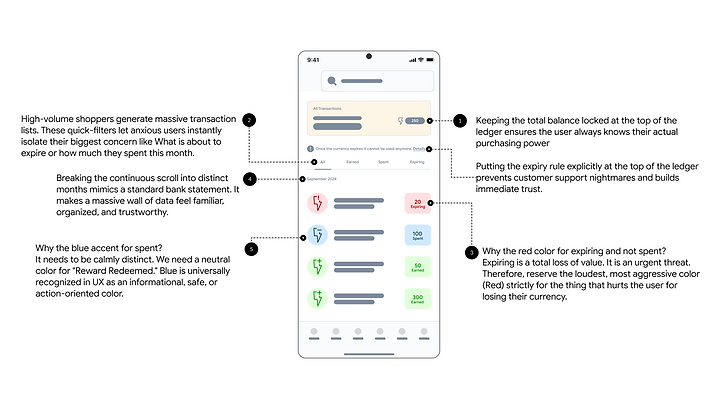
I initially treated it like a standard rewards history, a simple list. Not rigorous enough. Then came the bigger realisation: banking colour logic doesn't translate. In banking, spending is red because it's a loss. In a loyalty program, spending your currency is a success. Applying banking colour logic would make users feel penalised for doing exactly what we wanted them to do.

What the wireframe solves
Blue for spent is calmly distinct, not alarming. Red strictly for expiring is the urgent threat. Monthly grouping makes a wall of transactions feel like a bank statement: familiar and trustworthy.

Colour alone never carries the meaning. Each icon state includes a symbol so users who are colourblind can identify the transaction type without relying on hue.
Accessibility — WCAG

PDP Integration
Finding the safe zone
The Amazon PDP is the most guarded, highest converting page on the platform. Every placement I proposed was rejected and I couldn't reinvent the structure. I had to find a zone close enough to the price to influence the buying decision, but compliant enough to actually get built.

What the wireframe solves
The existing cashback and offers zone beneath the price was already there and compliant, proximity to the price, and overcomeable with a coloured icon that broke through the grey text.


Directions rejected by page owners
Every attempt to introduce new real estate or modify existing price components was blocked by guidelines and stakeholder pushback.
New price block placement
Above the fold injection
Price component edit
Did it work?
I left this project mid-way to pursue my Master's in Germany, so there are no post-launch metrics to share because the product is still in developement. A positive internal prototype survey conducted by my project lead with Amazon employees, senior designer reviews, and cross-team alignment sessions.
3
Touchpoints delivered from brief to handoff
2
Senior UX designers reviewed the work
Internal prototype survey had a positive feedback
0→1
Built from scratch with no prior template
Internal Prototype Survey
Positive feedback from Amazon employees on the prototypes
A small internal survey was conducted by my project lead with Amazon employees before I left. The prototypes were tested and feedback was collected and the response was positive across all three touchpoints.
"The best validation I had access to before leaving, and it pointed in the right direction."
Senior UX review — Ledger information hierarchy

Getting feedback from Senior UX Designers Manas S. and Ankit Prajapati (now Senior UX Designer at Google) on the ledger's information hierarchy, a key moment that reshaped how I approached the colour system.
Senior Designer Sign-off
Reviewed and shaped by two senior UX designers
Feedback from Manas S. and Ankit Prajapati (now Senior UX Designer at Google) on the Ledger's information hierarchy reshaped how I approached the entire colour system was a key moment in the project.
Cross-team alignment — PDP integration session

UX team reviewing and aligning on design decisions
Where it stands
The product is in active development. I handed off three complete touchpoints and the work continues without me.
In development · Handed off
Looking back
Designing the Loyalty Currency was a masterclass in enterprise UX and balancing gamified marketing with financial trust, at Amazon's scale. The biggest thing I'd change was bringing real users into the PDP exploration earlier. We spent weeks on rejected placements. One test might have gotten us there faster, with evidence instead of arguments.
The team — farewell dinner · August 2024

Amazon India UX team · last night in bengaluru before leaving for Germany
A note from Ankit · Senior UX Designer, now at Google - Ashish · Senior UX Designer, at Amazon - Prandeep · Senior UX Designer, at Amazon

"Best wishes to you, Anubhav · keep your colours alive"